Durga Puja: A Pledge of Harmony, a Question of Security
Durga Puja: A Pledge of Harmony, a Question of Security Autumn’s white clouds, swaying kash flowers and the beat of the dhak herald the return…


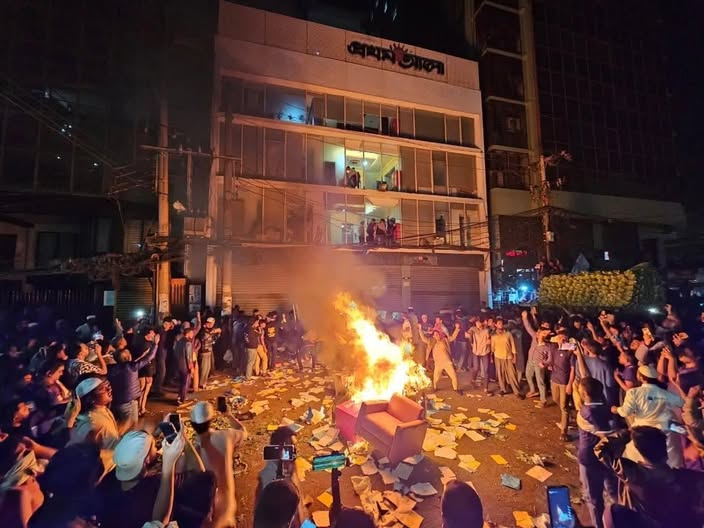
There is a particular kind of violence that does not make it to the front page after the first week. It is the violence that continues quietly, in small towns and lower courts, long after the television cameras have gone home and the world has decided that the story is over. This is what has been happening to the leaders, workers and ordinary supporters of the Bangladesh Awami League since 5 August 2024.
A change of government is not a licence for mob rule. Supporters of the previous government do not forfeit their right to life, to property, to a fair trial, or to walk into a courtroom without being pelted with bricks. That principle has been tested and found wanting in Bangladesh over the past two years.
The Night of August 5, 2024: A Nation in Turmoil
When news broke that Sheikh Hasina had resigned and left Bangladesh, widespread violence erupted across the country. Awami League offices were set ablaze. The homes of local leaders were ransacked. In Jashore, a hotel owned by the district Awami League general secretary was set alight, and the fire killed people who had nothing to do with politics at all, ordinary guests caught inside a building that was not their fight. In Narail, the home of a former national cricket captain turned Awami League parliamentarian was burned to the ground. In Dhaka, the private home of a former home minister was broken into and looted.
Human Rights Watch documented this vandalism within days of the resignation and called on the interim authorities to protect people from mob attacks. That call has gone largely unheeded for two years.
The Burning of a Memory
If there is a single image that captures the severity of the violence, it is the destruction of the house at Dhanmondi 32 in Dhaka. This was not merely a house, a party office, or simply a museum. It was the family home of Sheikh Mujibur Rahman, the man regarded as the founder of Bangladesh, and it had stood for decades as the Bangabandhu Memorial Museum, a place of national memory rather than partisan combat. In February 2025, following online calls for what organizers themselves described as a bulldozer procession, a mob smashed its way in, looted what remained and set it on fire. Murals and statues of the founding leader were pulled down and defaced in districts across the country in the same wave.
A nation is entitled to reassess its own history. It is not obliged to do so with a bulldozer and a can of petrol. When a country burns the physical memory of its own founding, it is not settling political scores. It is trying to erase a chapter of itself, and that should worry every citizen regardless of party.
Homes, Not Battlefields
Long after the initial fury of August 2024 had supposedly cooled, the violence continued. In February 2025, the Banani residence in Dhaka of Awami League Presidium Member Sheikh Selim was torched. Around the same period, the Companiganj, Noakhali, home linked to the family of former General Secretary Obaidul Quader was ransacked. These incidents were not spontaneous street clashes between rival crowds. They were organized strikes on private homes, often with local police either absent or unwilling to intervene, months after the change of government had already been consolidated.
A family’s home is not a legitimate target in a political transition, however bitter that transition has been. Women, children and elderly relatives who hold no office and cast no vote on anyone’s behalf were made to pay the price for surnames and party cards.
Courts Turned Into Gauntlets
Perhaps the most troubling pattern of all is what has happened inside the one institution that is supposed to stand above the mob, the judiciary. Detainees being walked from prison vans into the Chief Metropolitan Magistrate Court in Dhaka have repeatedly been pelted with eggs, shoes and bottles, and in several documented cases physically struck, while police cordons proved too thin to hold back the crowds. Women political activists have also been physically assaulted on court premises on numerous occasions. No one, whether old, a woman, or sick, was spared from mob attacks in the court area, a place traditionally considered one of the most secure in the country. Advocates who agreed to represent accused Awami League figures have themselves been assaulted outside court premises for the simple act of doing their professional duty.
A justice system in which the accused cannot walk from a van to a courtroom without being beaten, and in which lawyers are attacked for defending clients, is not delivering accountability. It is delivering theatre, and it is teaching the next generation of Bangladeshi lawyers that representing the wrong client is physically dangerous. That lesson will outlast this particular government, whichever government eventually comes next.
A Party Banned, A Movement Driven Underground
In October 2024 the student wing of the party, the Chhatra League, was banned under anti terrorism legislation. By May 2025 the interim government had gone further, formally proscribing all political activity of the Awami League itself, one of the two parties that has governed Bangladesh for most of its existence since independence. Banning an entire party, rather than prosecuting individuals for specific crimes with evidence tested in open court, sends millions of ordinary voters, people who simply marked a ballot paper for a particular symbol, the message that their political choice has itself become a criminal offence.
The Human Cost Nobody Agrees On
One of the most troubling features of this entire episode is that nobody, not the present government, not the interim government, and not independent monitors, can agree on how many of the Awami League workers and leaders have been killed since August 2024. Local human rights groups have documented custodial deaths in places such as Bogura and other jails. The Awami League’s own accounting, which the United Nations has said it could not independently verify, puts the number of its members and affiliates killed in the hundreds. Independent bodies such as Ain o Salish Kendra and the Human Rights Support Society have tracked killings, lynchings and custodial deaths running into the hundreds over this transitional period.
That the exact figure remains contested two years on is itself deeply troubling. A state committed to establishing the truth would have commissioned an independent and transparent accounting long ago. The absence of one leaves families without closure, while competing political narratives obscure or minimise the true death toll. Meanwhile, grieving relatives are left waiting for their loved ones’ names to be officially confirmed on any list at all.
Where the World Has Been
International response to all this has been curiously muted, at least when set against the volume of documentation that already exists. Human Rights Watch flagged the arson and vandalism within days in August 2024. The European Union Agency for Asylum has since published detailed country guidance describing the treatment of Awami League officials and supporters as a basis for asylum claims, which is itself a quiet acknowledgment that the danger is considered real and ongoing by European asylum authorities. Yet there has been no sustained diplomatic pressure on Dhaka comparable to what followed the matters of July and August 2024, and no comparable global media attention to the burning of homes, the banning of a party or the stoning of prisoners on courthouse steps.
Freedom of assembly and freedom of speech are not privileges that a government extends only to the side it currently favors. A press so cautious about criticizing the government that, by the UN’s own fact finding report, journalists now practice a kind of reverse self censorship, has told its own story about how contested the space for dissent has become in today’s Bangladesh, regardless of which party happens to hold power.
What Accountability Actually Requires
None of this is an argument for amnesty. The International Crimes Tribunal, whose jurisdiction to try cases beyond the crimes committed during the 1971 Liberation War remains the subject of significant debate, has handed down verdicts, including against Sheikh Hasina in absentia. A justice process is legitimate only when it meets basic fair trial standards: defense lawyers must be permitted to do their work without being beaten or threatened, accused must not be intimidated in connection with criminal cases, and evidence rather than mob pressure must determine the outcome.
What cannot be defended, under any government or under any party’s banner, is a court detainee being struck by projectiles before ever reaching the dock, a widow’s home being burned because her son once held a student union post, a twelve year old being killed over a Facebook post, or a woman being hacked to death while at prayer. These are not the actions of a state pursuing justice. They are the actions of a society that has decided that the rule of law is optional when the other side is the one asking for it.
There has always been political and social conflict in Bangladesh, but it has never been like the present situation, swinging between two dominant parties and two cycles of retribution, each promising that the last time will be the final time. It will not be the final time unless someone, inside the country or watching from outside it, insists that the next transfer of power, whenever and to whomever it comes, is not accompanied by burning houses, banned parties, and bleeding defendants dragged past a crowd that has already decided their guilt. Until that insistence arrives and is heeded, every claim by every party in Bangladesh to stand for democracy will remain, at best, unfinished business.
Chronological Record of Incidents Against Bangladesh Awami League Leaders, Workers and Supporters
A reference listing organized by category, then by date, drawn from documented reporting between August 2024 and August 2026.
Note on figures. Several of the aggregate death tolls quoted below vary depending on the source. Where a count comes from the Awami League’s own published list rather than an independent monitor, that is noted, since it should be read as a party claim rather than an independently verified figure.
This is not a complete list, as many incidents have yet to be documented.
Category One, Killings and Murders of Individuals
August 4 to 6, 2024, At least 87 Awami League members and affiliates were killed nationwide in the 48 hours surrounding Hasina’s resignation, according to tallies compiled by Prothom Alo. A separate report describes bodies of 29 Awami League leaders and relatives being recovered from various sites over a 24 hour window on August 6.
August 5, 2024, Jashore At least 24 people were killed, including an Indonesian national, when a mob set fire to the Zabir International Hotel, owned by district Awami League General Secretary Shahin Chakladar.
August 5, 2024, Dhaka Six people, including five teenagers, were killed when the residence of former Dhaka Counselor Muhammad Sha Alam was torched.
August 5, 2024 At least four people were killed when the home of Awami League MP Shafi Islam Shimul was set on fire.
August 13, 2024, Bogura Babar Ali, an Awami League worker, was abducted and killed, his throat slit.
September 8, 2024, Rajshahi Abdullah Al Masud, a former Rajshahi University Chhatra League leader who had been physically disabled in an earlier political attack in 2014, was cornered and beaten to death by a mob while out buying medicine.
December 5, 2024, Nachol Arina Begum was hacked to death while praying at home. She was targeted because her son was the local Chhatra League president and had gone into hiding.
December 17, 2024, Chapainawabganj Twelve year old Mohd Rian and Chhatra League supporter Masud Rana were killed in Nachol, reportedly targeted over a social media post supporting the party made months earlier.
July 16, 2025, Gopalganj Four to five people were killed when an opposition rally clashed directly with remaining Awami League loyalists in Hasina’s ancestral hometown. Several vehicles were also burned.
Category Two, Houses and Property Burned or Looted
August 5, 2024, Dhaka The Bangabandhu Memorial Museum at Dhanmondi 32, the historic residence of founding leader Sheikh Mujibur Rahman, was ransacked and set on fire. The 140 year old home of Baul singer Rahul Ananda in the same Dhanmondi locality was torched the same day.
August 5, 2024, Dhaka The private residence of former Home Minister Asaduzzaman Khan Kamal was broken into, looted and burned.
August 5, 2024, Narail The residence of Awami League MP and former national cricket captain Mashrafe Bin Mortaza was broken into, looted and destroyed by fire.
August 6, 2024, Barishal The Divisional Awami League office in Barishal was ransacked and set on fire.
February 5 to 7, 2025, nationwide Following calls for a bulldozer procession ahead of a virtual address by Sheikh Hasina, mobs again attacked the Dhanmondi 32 property, and murals and statues of Sheikh Mujibur Rahman were defaced or demolished in nearly two dozen districts.
February 7, 2025, Banani, Dhaka The residence of Awami League Presidium Member Sheikh Selim was set on fire.
February 2025, Noakhali The residence of former General Secretary Obaidul Quader was attacked in Companiganj. In the nearby Bora Rajapur Mohalla area, the properties of Abdul Quader Mirza, Companiganj Awami League President, and Shahadat Mirza, former Basurhat Mayor, were ransacked and looted.
February 2025, Bagha and Charghat, Rajshahi A group of more than 100 people on motorbikes raided and burned the residence of a local Awami League Vice President.
Category Three, Custodial Deaths
November to December 2024, Bogura Four detained Awami League leaders died in Bogura jail under circumstances their families and rights monitors have called suspicious.
May 2025, The Awami League, operating largely underground, stated that 21 of its leaders and activists had died in state custody under circumstances it described as highly suspicious. Independent estimates from human rights groups put total custodial and related deaths considerably higher across the full period.
Late 2025, Former minister Nurul Majid Humayun died in state custody. His family alleged he was denied necessary medical treatment.
February 2026, Former Water Resources Minister Ramesh Chandra Sen died in prison custody. His family again alleged medical neglect.
April 2026, SM Ziaul Haque Zia died in prison custody after months of detention. Human rights concerns were raised over his medical treatment and repeated denial of bail.
Category Four, Attacks on Detainees and Lawyers at Court
August 14, 2024, Dhaka Salman F. Rahman, former private industry advisor, and Anisul Huq, former Law Minister, were pelted with eggs and physically assaulted by a mob outside the Chief Metropolitan Magistrate Court.
August 19, 2024, Dhaka Workers Party President Rashed Khan Menon and Jatiya Samajtantrik Dal President Hasanul Haq Inu were punched, kicked and had shoes thrown at them at the Dhaka court gates during a remand hearing transfer.
August 25, 2024, Dhaka Former Commerce Minister Tipu Munshi and former Social Welfare and Education Minister Dr Dipu Moni were struck by bottles, shoes and eggs thrown by a crowd at the Chief Metropolitan Magistrate Court.
October 17, 2024, Dhaka Advocate Sheikh Farid, one of the few lawyers willing to represent accused Awami League leaders, was beaten by a group of lawyers and outsiders outside the court building.
November 2024, Dhaka and regional courts Former State Minister for ICT Zunaid Ahmed Palak and several former local MPs were attacked during transit between prison and court premises.
May 22, 2025, Manikganj Former MP and folk singer Momtaz Begum had her prison van intercepted, its windows shattered by a mob throwing eggs and shoes during a remand hearing.
Category Five, Women Workers and Leaders Specifically Targeted’
December 5, 2024, Nachol Arina Begum, hacked to death while praying, targeted because of her son’s political role. Listed separately here as an attack specifically against a woman party relative rather than an officeholder herself.
May 22, 2025, Manikganj Momtaz Begum, folk singer and former Awami League MP, physically endangered when her prison van was attacked.
Category Six, Violence Linked to Religious Minority Status
August 4 to 20, 2024, nationwide The Bangladesh Hindu Buddhist Christian Unity Council tracked 2,010 attacks on religious minorities in this window. Of these, at least 506 properties belonging specifically to Hindu Awami League politicians or supporters were looted or destroyed, and reporting identifies at least two Hindu individuals killed in this period who were confirmed Awami League members.
Category Seven, Institutional and Legal Milestones Affecting the Party
October 23, 2024 The interim government banned the Bangladesh Chhatra League, the Awami League’s student wing, under the Anti-Terrorism Act.
May 12, 2025 The interim government formally banned all political activities of the Bangladesh Awami League.
November 2025 Special tribunals began issuing verdicts against former leaders of the ousted administration, including a death sentence for Sheikh Hasina in absentia, amid continued localized violence.
Special Notes:
February 2026, A Transparency International Bangladesh report documented 158 deaths and more than 7,000 injuries resulting from political violence. The report attributed more than 91 percent of the violence to BNP-linked actors, while Awami League supporters were reported as both participants in and targets of a significant share of the clashes.
June 2026, On the Awami League’s 77th anniversary, the party was prevented from holding public rallies. The party itself claimed that more than 500 leaders, activists and supporters had been killed since the 2024 political transition.
August 2026, Human Rights Watch called for an end to prolonged pretrial detention of political opponents, citing concerns about arbitrary detention, inadequate medical care and deaths in custody, including among elderly Awami League members.
The writer draws on documentation from Human Rights Watch, the Office of the United Nations High Commissioner for Human Rights, the European Union Agency for Asylum, and Bangladeshi human rights organizations, including Ain o Salish Kendra and the Human Rights Support Society. Casualty figures remain disputed among different parties and sources and are presented here with appropriate caution.
Parvez Hashem
Lawyer and Human Rights Defender


Durga Puja: A Pledge of Harmony, a Question of Security Autumn’s white clouds, swaying kash flowers and the beat of the dhak herald the return…
OTN Bangla Desk: A 52-year-old fish farmer was allegedly beaten to death on suspicion of stealing fish from a fish enclosure in Tala upazila of…
The death of Wahiduzzaman Shamim in Satkhira exposes the danger of mob violence in Bangladesh. According to police, the 30 year old man was beaten…
OTN Bangla Desk: Former Bangladesh Prime Minister Sheikh Hasina has criticised Prime Minister Tarique Rahman for declining to attend the BRICS summit in India. In…

I am not an avid reader, but I do go through a book whenever I can make time for it. The last audiobook I finished…
OTN Bangla Desk: Land and property disputes, disappearances, kidnappings, physical assaults, attacks on religious sites, murders and mysterious deaths feature in the July–September 2026 quarterly…
Reports about General Waker-Uz-Zaman’s future have fuelled speculation, while ISPR has warned against misleading information. No confirmed government announcement of his removal has been cited….
A Festival Overshadowed by Fear As Bangladesh’s Hindu community prepares for Durga Puja, reports of idol vandalism in several parts of the country have cast…




All Rights Reserved by © OTN Bangla.com.au - 2026 | Privacy Policy | Terms of Use | Editorial Policy | Proudly Developed by @SSB it.au