Australia

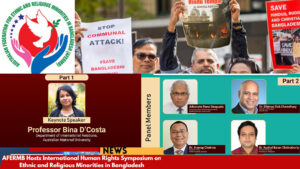
AFERMB Hosts International Human Rights Symposium on Ethnic and Religious Minorities in Bangladesh

  • 11:11 pm - February 28, 2026
At the international human rights symposium titled “Ethnic and Religious Minorities in Bangladesh: Rights, Realities, and Future Pathways,” organised by AFERMB, experts, researchers, and human rights advocates from around the world participated online on 28 February 2026.

Melbourne, February 28: The Australian Federation for Ethnic and Religious Minorities in Bangladesh Ltd (AFERMB) today convened an International Human Rights Symposium titled “Ethnic and Religious Minorities in Bangladesh: Rights, Realities, and Future Pathways” on 28 February 2026 via Zoom, drawing around 100 participants from across the world.

The online symposium brought together academics, human rights advocates, legal experts and community leaders to examine the historical and contemporary challenges faced by minorities in Bangladesh, and to explore possible pathways for reform and protection.

Opening Session

The event commenced with an introductory address by Amal Dutta, one of the Directors of AFERMB, who outlined the organisation’s background, objectives and housekeeping guidelines. He highlighted AFERMB’s commitment to advocacy, research and global engagement concerning minority rights in Bangladesh.

This was followed by an Acknowledgement of Country delivered by Swapan Paul, also a Director of AFERMB, recognising Indigenous custodians of the land and affirming solidarity with marginalised communities worldwide.

Keynote Address

The keynote session was chaired by Professor Dr Jahar Bhowmik of Swinburne University of Technology. The keynote address was delivered by Professor Bina D’Costa from the Department of International Relations at Australian National University. Professor D’Costa presented a comprehensive analysis of minority rights within the broader framework of international human rights. She discussed the concept of precarity and examined how minorities in Bangladesh have historically been targeted during periods of political unrest.

Her presentation explored key questions, including: Who qualifies as a minority under international human rights law? How have colonial census practices and communal representation shaped identity politics? How has the rise of communal politics influenced state and societal responses to minorities?

Professor D’Costa emphasised that Bangladesh lacks comprehensive legal protections specifically safeguarding minority communities. She argued that both the absence of targeted laws and weak implementation of existing anti-discrimination provisions have contributed to recurring incidents of violence and marginalisation.

Drawing on reports from national dailies and other documented accounts, she outlined patterns of attacks on Hindu, Buddhist and other minority communities under successive governments, noting that some incidents have gone unreported in mainstream media. The keynote concluded with an interactive question-and-answer session.


Panel Discussion: Historical Patterns and Contemporary Challenges

The second session featured a panel discussion ably led by Dr Swapan Paul, Engr. Dilip Dutta and Engr. Sharmistha Saha, who thoughtfully facilitated the dialogue and guided the exchange among the panellists, ensuring a constructive and engaging discussion.

Samir Sarkar, a Member of the Board of Directors of AFERMB, had to leave before the symposium formally concluded; therefore, he delivered the vote of thanks earlier in his official capacity, pending the continuation of the discussions.

Dr Dhiman Deb Chowdhury of the US-based Human Rights Congress for Bangladesh Minorities presented on recurring genocidal crimes against minorities from 1946 to the present, analysing contemporary developments within a broader historical continuum.

Hosted by Engr. Dilip Dutta, the first presentation was delivered by Dr Dhiman Deb Choudhury of the Human Rights Congress for Bangladesh Minorities (HRCBM), based in the United States. His presentation examined what he described as recurring genocidal crimes against minorities from 1946 to the present, situating contemporary developments within a long historical trajectory. Referring to Bengal’s political transition in 1204 and subsequent historical transformations, Dr Choudhury described what he characterised as centuries of persecution and gradual demographic decline of minority populations. He questioned whether demographic shifts reflected natural processes or elements of ethnic cleansing.

His recommendations included strengthening scholarly contributions, expanding advocacy and international engagement, pursuing legal action and litigation, and establishing mechanisms for rescue and family reunification where necessary.

The panel also included Advocate Rana Dasgupta, freedom fighter and General Secretary of the Bangladesh Hindu Buddhist Christian Unity Council, Dr Anurag Chakma and Dr Kushal Baran Chakraborty.

Advocate Rana Dasgupta focused on the future of minorities in Bangladesh, underscoring the need for unity and sustained advocacy.

Dr Kushal Baran Chakraborty spoke about the multifaceted challenges facing Hindus in Bangladesh. He cited financial hardship among minority students, religious conversion pressures, alleged failures to prosecute perpetrators of communal violence including the Nasirnagar attacks, budgetary discrimination, and negative propaganda targeting minorities.

He expressed concern over what he described as limited mainstream media coverage of minority issues and advocated for stronger unity among Hindus, the development of trusted media platforms, enhanced global communication networks, and coordinated online engagement.

Sharing personal experiences, Dr Chakraborty recounted incidents of mob violence and intimidation, including events surrounding the arrest of Chinmoy Krishna Das and disturbances during a professional promotion interview at the Vice Chancellor’s office of Chittagong University.

Dr Anurag Chakma presented findings from ongoing research into violence against indigenous minorities during the 2024 political transition in Bangladesh. He emphasised why political transitions are critical periods for minority vulnerability and highlighted patterns of violence affecting indigenous communities. He also suggested the need for early warning mechanisms, stronger constitutional safeguards, independent investigations into incidents of violence, and coordinated national and international advocacy to ensure accountability and long-term protection for indigenous minority groups.

At the conclusion of the programme, Professor Dr Jahar Bhowmik of Swinburne University of Technology conveyed his sincere appreciation to the keynote speaker, distinguished panellists, organisers and participants from around the world for their insightful and meaningful contributions. He reaffirmed the vital importance of sustained academic engagement, informed dialogue and collective advocacy in advancing the protection and promotion of minority rights. In his remarks, Professor Bhowmik highlighted several critical and pressing issues. These included constitutional limitations that continue to affect minority protections, the absence of comprehensive anti-discrimination legislation, and the ongoing challenges in ensuring the full implementation of constitutional guarantees relating to religious freedom and freedom of worship.

Furthermore, he emphasised that prevailing political dynamics remain a central factor contributing to the continued marginalisation of minorities in Bangladesh, particularly in relation to limited access to justice and institutional redress for affected communities.

Organisers described the event as an important step towards fostering international dialogue, strengthening research collaboration, and advancing advocacy for the rights and protection of ethnic and religious minorities in Bangladesh.

Related News

Hasina Plans December Return to Bangladesh to Surrender Before Court: Reuters Exclusive

Melbourne, 11 July: Bangladesh’s ousted Prime Minister Sheikh Hasina has said she and several senior leaders of the Awami League plan to return to Bangladesh…

PM Modi’s High-Voltage Australia Visit Strengthens Strategic and Economic Partnership

Melbourne July 9, 2026: Indian Prime Minister Narendra Modi’s high-profile visit to Australia marked a significant milestone in bilateral relations, combining high-level diplomacy, strong economic…

Political Violence Death Toll Rises in Bangladesh in June: HRSS Report

Melbourne, July 3: Political violence in Bangladesh intensified in June, with both deaths and injuries increasing compared to the previous month, according to a new…

Hindu Student and Assistant Priest Abducted, Tortured for Ransom in Dhaka

Dhaka, 1 July 2026: A 25-year-old Hindu student and part-time assistant priest has allegedly been abducted, tortured, and forced to pay ransom after being taken…

Iran-Backed Group Could Carry Out Attacks and Assassinations in Australia, ASIO Warns

Melbourne, June 26: Australia’s domestic intelligence agency has warned that an Iran-backed group could carry out acts of violence, including arson, vandalism and even targeted…

AFERMB Condemns Alleged Disrespect to Lord Ram’s Image in Bangladesh, Calls for Protection of Minority Rights and Religious Sites

Melbourne, June 20: The Australian Federation for Ethnic and Religious Minorities in Bangladesh (AFERMB) has expressed deep concern and strong condemnation over recent incidents involving…

Socceroos Suffer Major Setback with 2-0 Defeat to USA

Melbourne, June 20: Australia’s Socceroos have suffered a significant blow to their World Cup campaign after a comprehensive 2-0 defeat to the United States in…

Is she real? World Cup “Supporter” Goes Viral as AI Image Leaves Fans Duped

Melbourne, June 14: A viral image of a supposed United States football supporter at the FIFA World Cup has taken social media by storm, but…

All Rights Reserved by © OTN Bangla.com.au - 2026 | Privacy Policy | Terms of Use | Editorial Policy | Proudly Developed by @SSB it.au