Durga Puja: A Pledge of Harmony, a Question of Security
Durga Puja: A Pledge of Harmony, a Question of Security Autumn’s white clouds, swaying kash flowers and the beat of the dhak herald the return…


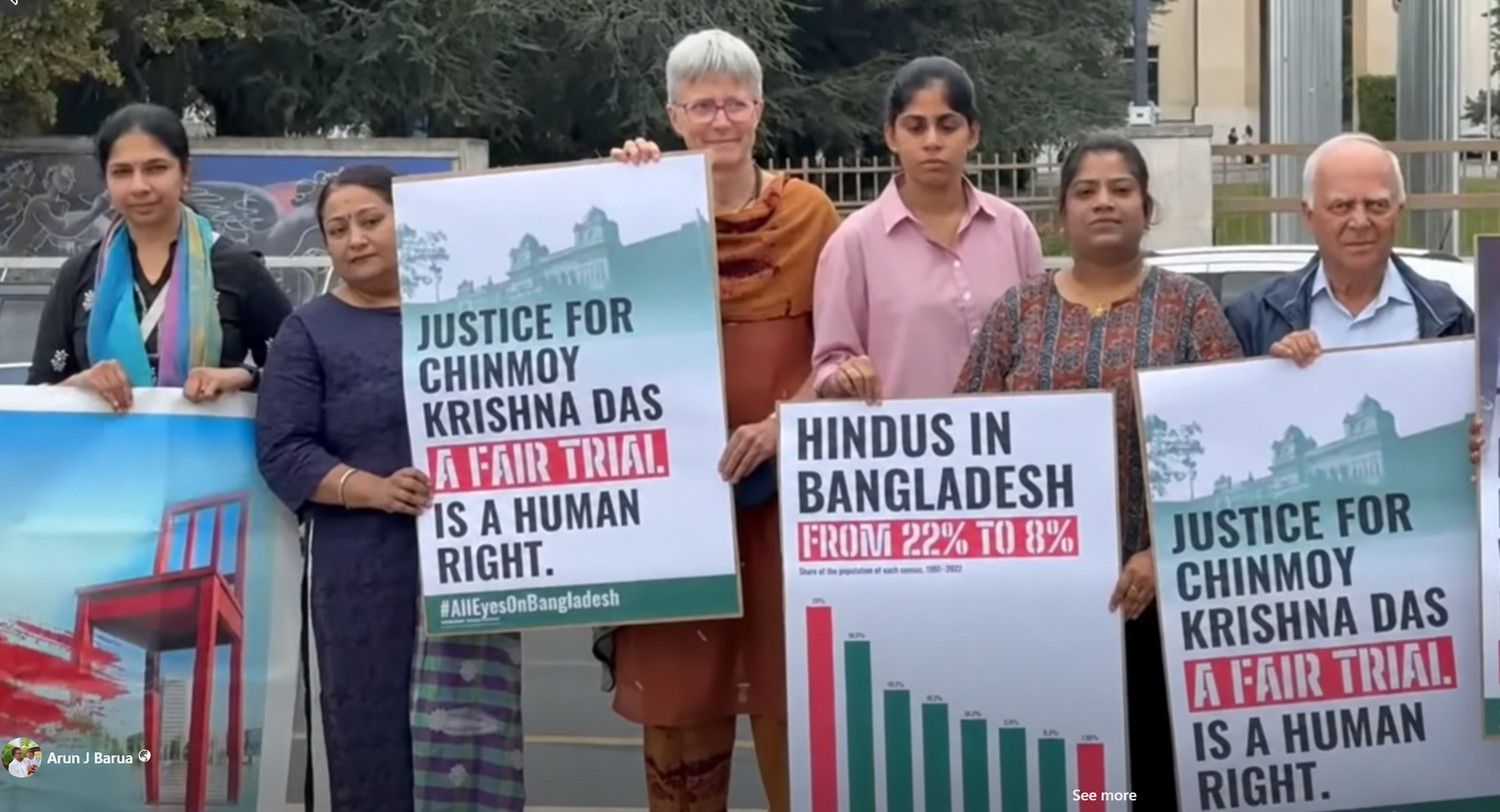
OTN Bangla Desk: A human-chain protest was held in Geneva, Switzerland, demanding protection for Bangladesh’s religious and ethnic minorities and the immediate release of Chinmoy Krishna Das.
Participants gathered near the symbolic Broken Chair sculpture, close to the United Nations Office at Geneva, on Wednesday, September 30, carrying placards highlighting their demands.
The protest took place during the UN Human Rights Council’s 63rd regular session. According to the UN Human Rights Office, the session runs from September 7 to October 7, 2026, at the Palais des Nations in Geneva.
Those attending included Hindu Buddhist Christian Unity Council leaders Amarendra Roy and Palash Barua, alongside Suman Chakraborty, Sunil Chakma and others.
Demonstrators urged the United Nations and the international community to monitor, document and help prevent alleged human-rights violations in Bangladesh. They also called for the release of Chinmoy Krishna Das, a Hindu monk and spokesperson for the Bangladesh Sammilit Sanatan Jagran Jote, and demanded a fair judicial process.
According to a Paris Telegraph report, Das has remained in custody since November 2024. Although courts granted him bail in several cases during 2026, he has not been released because other cases remain pending. These include proceedings connected to the death of lawyer Saiful Islam Alif during violence outside a Chattogram court in November 2024.
Protesters expressed concern over his continued detention and called for justice through a fair legal process.
Participants displayed placards calling for an end to the persecution of Hindus and greater protection for minority women and girls. They also demanded accountability for alleged attacks on temples, desecration of places of worship and looting of homes.
A poster featuring Chinmoy Krishna Das alleged that he had been denied permission to see his dying mother.
UK government country information cited in the Paris Telegraph report puts Bangladesh’s Hindu population—the country’s largest religious minority—at approximately 8 per cent, or around 13 million people. The information notes that Bangladesh’s constitution provides equal status and rights for other religions, while communal violence has occurred, particularly during periods of political upheaval.
Paris Telegraph also reported that the Bangladesh Hindu Buddhist Christian Unity Council said in July that it had documented 257 incidents of communal violence during the first six months of 2026, including 44 deaths. Its records included alleged attacks on places of worship, homes and businesses, alongside other abuses. These figures represent the organisation’s own documentation and have not been independently verified in full.
The demonstration also raised separate concerns about the security of Indigenous peoples, land rights and militarisation in the Chittagong Hill Tracts.
One banner called for an end to what protesters described as “ethnic cleansing” in the region. Other demands included recognition of Indigenous peoples’ ethnic and land rights.
Although the gathering was small, participants sought to bring their concerns to an international audience by protesting near the UN’s human-rights institutions.
Their central message was that all citizens, whether belonging to minority or majority communities, should enjoy equal protection, dignity and rights under the law. They appealed to the United Nations to give attention to their concerns and called for proper investigations into allegations of human-rights violations in Bangladesh.


Durga Puja: A Pledge of Harmony, a Question of Security Autumn’s white clouds, swaying kash flowers and the beat of the dhak herald the return…
OTN Bangla Desk: A 52-year-old fish farmer was allegedly beaten to death on suspicion of stealing fish from a fish enclosure in Tala upazila of…
The death of Wahiduzzaman Shamim in Satkhira exposes the danger of mob violence in Bangladesh. According to police, the 30 year old man was beaten…
OTN Bangla Desk: Former Bangladesh Prime Minister Sheikh Hasina has criticised Prime Minister Tarique Rahman for declining to attend the BRICS summit in India. In…

I am not an avid reader, but I do go through a book whenever I can make time for it. The last audiobook I finished…
OTN Bangla Desk: Land and property disputes, disappearances, kidnappings, physical assaults, attacks on religious sites, murders and mysterious deaths feature in the July–September 2026 quarterly…
Reports about General Waker-Uz-Zaman’s future have fuelled speculation, while ISPR has warned against misleading information. No confirmed government announcement of his removal has been cited….
A Festival Overshadowed by Fear As Bangladesh’s Hindu community prepares for Durga Puja, reports of idol vandalism in several parts of the country have cast…




All Rights Reserved by © OTN Bangla.com.au - 2026 | Privacy Policy | Terms of Use | Editorial Policy | Proudly Developed by @SSB it.au