
Bangladesh

Should Bangladesh Join the Mecca Pact? Analysts Warn of Diplomatic and Security Risks

  • 10:05 pm - August 26, 2026
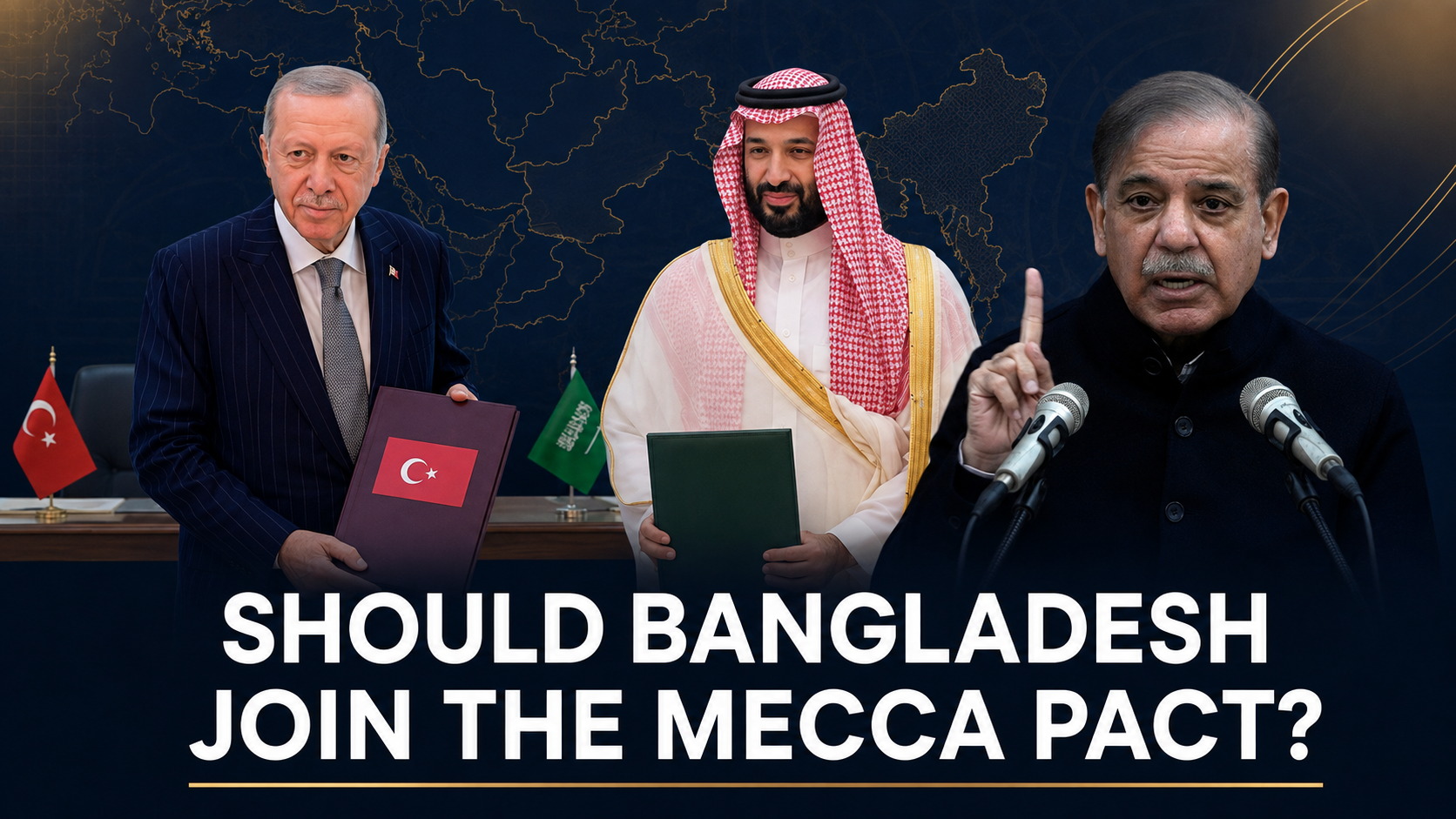
Various diplomatic and security questions have been raised regarding Bangladesh's possible participation in the 'Makkah Joint Defense Pact' between Turkish President Recep Tayyip Erdogan, Saudi Crown Prince Mohammed bin Salman and Pakistani Prime Minister Shehbaz Sharif - a three-nation alliance. Photo: OTN Bangla

Melbourne, 26 August: Bangladesh’s potential participation in the Mecca Joint Defence Agreement—signed by Saudi Arabia, Türkiye and Pakistan—has raised significant diplomatic, economic and security questions.

The three countries signed the agreement on 7 August to strengthen cooperation amid their respective security challenges. Saudi Arabia faces tensions involving Iran, Houthi attacks and instability around the Red Sea. Türkiye has security interests spanning Syria, Iraq, Libya and the Caucasus, while Pakistan confronts border tensions and militant violence at home.

Although closer defence cooperation may serve the interests of those countries, their security priorities do not necessarily align with Bangladesh’s needs, according to advocate, human rights activist and political analyst Kollol Kibria.

In an analysis published by Asia News Network, Kibria argued that Dhaka should carefully consider the diplomatic, economic and security implications before joining the pact or any similar military alliance.

Middle Eastern conflicts are not Bangladesh’s conflicts

Kibria argued that Bangladesh should not import the Middle East’s “architecture of conflict” into its foreign policy.

A country maintaining friendly relations with Bangladesh today could become an adversary of one of its military partners in the future. Membership in such an alliance could consequently create unnecessary diplomatic tensions and restrict Dhaka’s ability to respond independently to international crises.

Bangladesh has no territorial dispute or military confrontation with Iran. If Saudi Arabia became involved in a future conflict with Iran, Bangladesh could face pressure to take sides as a member of the pact. Such a development could damage Dhaka’s relationship with Tehran while placing its economic and energy interests at risk.

Bangladesh should retain the freedom to assess every crisis on its merits and respond according to its national interests, rather than the geopolitical calculations of military partners, the analysis said.

Collective-defence provision raises concerns

The Mecca Pact reportedly contains a collective-defence provision under which an armed attack against one member would be regarded as an attack against all members. The arrangement has been compared with Article 5 of the North Atlantic Treaty.

This provision could turn a conflict involving one member into a security concern for Bangladesh—even when Dhaka had no direct connection to the dispute.

“No treaty should automatically turn another country’s enemy into Bangladesh’s enemy or commit Bangladeshi soldiers to a conflict the country did not choose,” Kibria wrote.

Economic and energy interests could be affected

Continuing tensions in the Middle East already pose risks to global energy supplies and international trade. A prolonged conflict could increase oil and liquefied natural gas prices as well as shipping and insurance costs, placing additional pressure on Bangladesh’s economy.

Saudi Arabia is an important labour market and economic partner for Bangladesh. The United Arab Emirates, Qatar, Kuwait and Oman are also major energy suppliers and important sources of remittances and investment. Millions of Bangladeshi families depend directly or indirectly on these relationships.

Maintaining balanced relations across the Gulf is therefore essential to Bangladesh’s economic interests, energy security and overseas employment opportunities.

Constitution supports an independent foreign policy

Article 25 of the Constitution of Bangladesh identifies respect for national sovereignty and equality, non-interference in other countries’ domestic affairs, peaceful settlement of international disputes, and adherence to international law and the UN Charter as central principles of the country’s foreign policy.

These principles have enabled Bangladesh to maintain relations with countries that may have serious disagreements with one another. In an increasingly divided world, preserving that diplomatic flexibility remains a significant strategic advantage.

Bangladesh’s geographical position also makes such flexibility particularly important. Located between India and Myanmar and connected to the Indian Ocean through the Bay of Bengal, the country depends heavily on international markets, maritime trade, imported energy, overseas employment and remittances.

Bangladesh therefore cannot afford to view international affairs solely through the security priorities of another country or military bloc.

Peacekeeping is different from joining a military alliance

Bangladesh has built a strong international reputation through its longstanding contribution to United Nations peacekeeping operations. Bangladeshi military and police personnel have served in difficult missions around the world, protecting civilians and supporting peace.

However, UN peacekeeping and membership in a collective military alliance involve fundamentally different obligations.

Peacekeepers operate under an internationally authorised mandate with a defined mission and legal framework. A collective-defence pact, in contrast, could oblige members to become involved when another member enters a conflict.

The analysis argued that Bangladesh should continue contributing to global peace rather than committing its soldiers to wars that do not directly serve the country’s interests.

Bangladesh must remain at the centre of its foreign policy

Although the world is becoming increasingly divided, Bangladesh’s ability to engage constructively with all sides remains one of its greatest diplomatic strengths. This flexibility gives Dhaka greater room to protect national security, trade, energy supplies, investment, overseas employment and remittance flows.

Kibria argued that Bangladesh should manage each bilateral relationship according to its own merits, cooperate widely and resist pressure to take sides in disputes unrelated to its national interests.

The country’s foreign policy, he concluded, must remain firmly centred on Bangladesh—guided by its security needs, economic priorities and independent judgement rather than the conflicts and rivalries of other states.

Related News

Rangpur quadruple murder: ASK finds inconsistencies in police account

The Ain o Salish Kendra (ASK), a Bangladeshi human rights organisation, has identified inconsistencies in the police account of the high-profile quadruple murder in Rangpur…

39 Australians Missing as Nepal–Tibet Border Flood Death Toll Reaches 469

At least 469 people have died and more than 1,000 remain missing following catastrophic flash floods and landslides along the Nepal–Tibet border. Australia’s Department of…

DU Honours 62 Researchers for Outstanding Contributions to Research

Dhaka University has honoured 62 teachers and researchers in recognition of their outstanding contributions to research and their role in enhancing the university’s visibility in…

Four Deaths, Two Suspects, Nine Yaba Tablets: The Unanswered Questions in Rangpur

Fresh questions have emerged over the police investigation into the killing of four members of a Hindu family in Daspara, Rangpur city, particularly over the…

Mamdani Opposes RSS Chief Mohan Bhagwat’s Manhattan Event, Citing Concerns Over Exclusionary Ideology

Melbourne, 27 August: RSS chief Mohan Bhagwat is scheduled to address an event in Manhattan on Saturday, 29 August, prompting objections from several individuals and…

Nepal Battles Deadly Flash Floods as Hundreds Remain Unaccounted For

Melbourne, 27 August: The death toll from devastating flash floods and landslides in Nepal’s areas bordering Tibet has risen to at least 98, with hundreds…

Students Form Human Chain at Shahbagh Seeking Full Investigation into Rangpur Family Murders

Melbourne, 26 August: Students formed a human chain at Shahbagh in the capital on Wednesday, demanding an impartial investigation, disclosure of the complete circumstances and a…

Protest Held in New York Demanding Justice for Murdered Hindu Family in Rangpur

New York August 26: Members of the Bangladeshi Hindu community and other concerned residents gathered in New York to demand a fair investigation and exemplary…

All Rights Reserved by © OTN Bangla.com.au - 2026 | Privacy Policy | Terms of Use | Editorial Policy | Proudly Developed by @SSB it.au