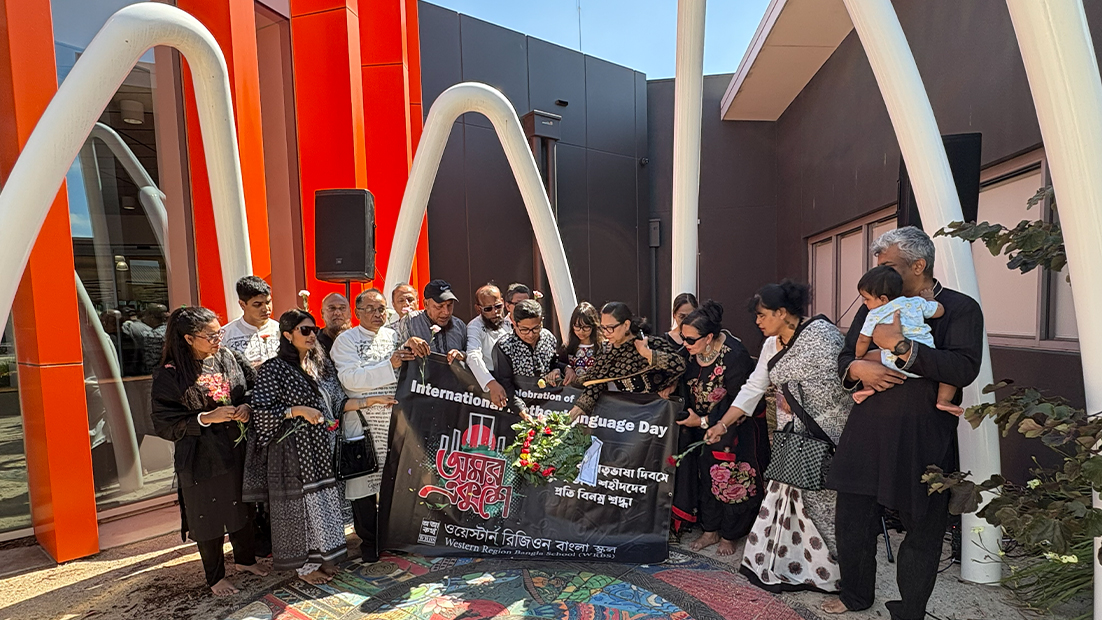
Community members, councillors and MPs gather at the Shaheed Minar at the Julia Gillard Library in Tarneit to mark International Mother Language Day. Image: OTN Bangla
Melbourne, February 21 — The Victorian Bangladeshi Community Foundation (VBCF) today organised a solemn and vibrant observance of International Mother Language Day at the Shaheed Minar located at the Julia Gillard Library precinct in Tarneit.
The programme began with a tribute to the language martyrs, followed by a welcome address by AKM Morshed Kamal, President of VBCF. In his speech, he highlighted the significance of February 21 in the history of the Bengali people and the universal importance of protecting linguistic diversity.

Local political leaders including Joanne Ryan MP, Dylan Wight MP joined the community to mark the occasion. Image: OTN Bnagla
Several local councillors and Members of Parliament addressed the gathering on behalf of their respective councils, expressing solidarity with the Bangladeshi community and acknowledging the global relevance of International Mother Language Day. After the formal tributes, the event moved into a cultural programme celebrating language, heritage and multicultural harmony.

MP and Labor candidate for Point Cook, Mathew Hilakari, speaks on the importance of preserving language and culture for future generations. Image: OTN Bangla
“MP and Labor candidate for Point Cook, Mathew Hilakari, said during his speech, ‘We must celebrate our language and culture in this way so that we can pass them on to the next generation. Without language, there is no culture.’”

Members of the local Bangladeshi community participated in the program. Image: OTN Bangla
Alongside Bangladeshi community organisations, representatives from various Sikh community groups also took part in the commemoration, reflecting the multicultural spirit of Victoria. Members of different Bangladeshi organisations joined in laying floral tributes at the Shaheed Minar, paying homage to the martyrs who sacrificed their lives for the Bangla language.

Along with the Bangladeshi community, members of the Sikh community also paid tribute to the language martyrs at the Shaheed Minar in Turnay. Photo: OTN Bangla
February 21, 1952, remains a defining moment in Bengali history. On that day, students took to the streets to protest against the then Pakistani rulers’ decision to impose Urdu as the sole state language. Police opened fire on demonstrators, killing Salam, Barkat, Rafique, Jabbar, Shafiur and many others whose names remain unknown. Their sacrifice ensured the recognition and survival of Bangla as a state language and later became a foundation of Bangladesh’s struggle for independence.
Today, February 21 is observed worldwide as International Mother Language Day following recognition by UNESCO. The journey to international recognition began on November 17, 1999, at UNESCO’s 30th General Conference in Paris, where a resolution was adopted declaring February 21 as International Mother Language Day. From 2000 onwards, the day has been observed in 188 countries, giving Bangla special recognition on the global stage and promoting respect for all languages.
The global recognition of February 21 was the result of sustained efforts by multilingual and multicultural language activists, particularly a group based in Canada. In March 1998, the group submitted a proposal to the United Nations Secretary-General, highlighting the unique struggle of the Bengali people to protect their mother tongue. Although the UN advised them to approach UNESCO in Paris, the campaign continued through correspondence and advocacy.
Nearly a year later, UNESCO responded positively to the proposal. In March 1999, a senior official from UNESCO’s language division acknowledged that the request to declare February 21 as International Mother Language Day was compelling. This paved the way for the historic decision later that year, turning a national day of remembrance into a global observance celebrating linguistic rights and cultural diversity.
The Tarneit event concluded with cultural performances and community interaction, reinforcing the message that the spirit of Ekushey is not only about remembering the past, but also about safeguarding linguistic diversity and mutual respect in multicultural societies like Australia.
-OTN Bangla
Read More