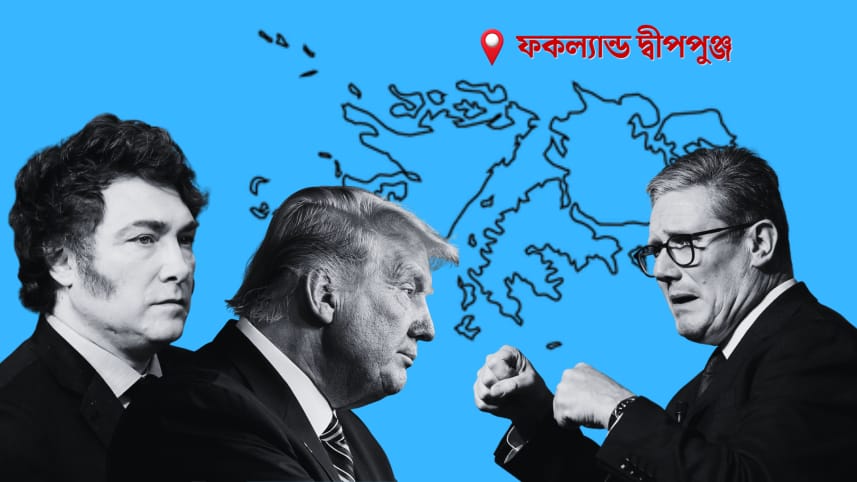
According to a report by Al Jazeera, Mileiās remarks came at a time when his relationship with US President Donald Trump is becoming increasingly close, while tensions between Trump and the United Kingdom appear to be growing. Trump and Milei have met several times, and the Argentine leader has frequently attended conservative political events in the United States aligned with Trumpās ideology. Trump has previously referred to Milei as his āfavourite president.ā

Argentina has once again asserted its claim over the British-controlled Falkland Islands, known locally as the Malvinas. Photo: Collected
Amid this evolving political alignment, the Trump administration reportedly brought the sovereignty issue of the Falkland Islands back into discussion in April. A leaked document from the US Department of Defense suggested reconsideration of Britainās sovereignty over the islands, partly linked to broader diplomatic disagreements involving the United Kingdomās stance on US-Israel-Iran related geopolitical tensions.
Shortly after the document surfaced, the United Kingdom reaffirmed its full sovereignty over the islands, as reported by the BBC. However, President Milei responded on social media platform X, stating that the islands āhave always been, are, and will always be Argentine.ā
US Secretary of State Marco Rubio later downplayed the significance of the leaked document, reiterating that Washingtonās moral and diplomatic position on sovereignty had not changed.
The dispute itself has deep historical roots. The United Kingdom has maintained control over the islands for nearly 200 years, asserting continuous and peaceful administration since 1833. Argentina, however, argues that the islands were inherited as part of its independence from Spain in 1816, and that Britain forcibly occupied them in the early nineteenth century.
The sovereignty debate has been extensively analysed by institutions such as Chatham House and covered by international media including Al Jazeera and Reuters. At its core, the issue involves competing legal and historical interpretations involving colonial succession, territorial discovery, and international law.
Spanish, British, and French historical claims all play a role in the narrative. Spainās claim is based on papal decrees and treaties from the late 15th century, while France briefly established settlements in the 18th century before ceding influence. Britain argues it established effective control through exploration, settlement, and sustained administration from the 18th and 19th centuries onward.
The islands were formally contested in 1833 when Britain reasserted control, expelling Argentine authorities. Since then, London has maintained uninterrupted governance, a fact it uses to support its sovereignty claim.
Argentina, however, maintains that British action constituted forceful occupation and that the islands were part of inherited colonial territory following independence from Spain. This disagreement escalated into the 1982 Falklands War, during which Argentina briefly occupied the islands before British forces regained control.
International law adds further complexity. Principles such as āself-determinationā and āuti possidetis jurisā are both cited by opposing sides. The UK emphasizes the right of the islanders to determine their political future, while Argentina argues that territorial integrity and colonial inheritance should take precedence.
A 2013 referendum held in the Falklands showed that over 99 percent of voters wished to remain a British Overseas Territory, a result London frequently cites in defence of its position. Argentina rejects this, arguing that the population is a result of British settlement and cannot override sovereignty claims.
Today, the United Nations still classifies the Falkland Islands as a non-self-governing territory and continues to encourage negotiations between the UK and Argentina. However, no breakthrough has been achieved, and both sides continue to hold firmly to their positions.
As global politics once again brings attention to the South Atlantic, the question remains unresolved: are the Falkland Islands a case of historical sovereignty, or a matter of modern self-determination? For now, the answer continues to divide nations, lawyers, and historians alike.
Shyamal Sanyal