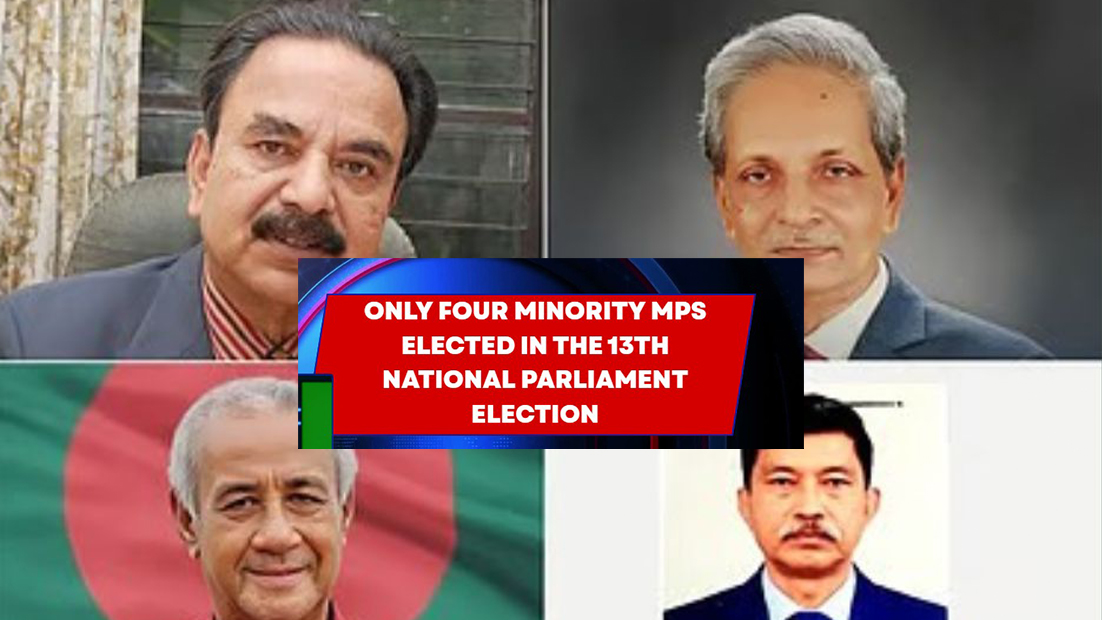
Representation from religious and ethnic minority communities has also declined sharply. Only four minority candidates were directly elected, all from the BNP. They are Goyeshwar Chandra Roy (Dhaka-3), Nitai Roy Chowdhury (Magura-2), Saching Pru (Bandarban), and Dipen Dewan (Rangamati).
Melbourne 14 February: Women’s and minority representation in Bangladesh’s Parliament has fallen to its lowest level in more than two decades following the 13th national election, despite the Bangladesh Nationalist Party (BNP) securing a landslide victory.
According to Election Commission data, only 84 women contested the election, making up just 4.08 per cent of the total candidate pool. Of them, only seven women were directly elected to Parliament, marking a sharp decline compared with recent elections. In the 12th national election in 2024, 19 women won general seats. The numbers were higher in the two preceding parliaments, with 22 women elected in 2018 and 18 in 2014. The highest figure in the past two decades was recorded in 2008, when 19 women were elected. The latest outcome is the lowest since 2001.
Among party nominees, the BNP fielded 10 women candidates, the National Citizen Party (NCP) three, the Jatiya Party six, and Gono Odhikar Parishad three. Jamaat-e-Islami and Islami Andolan Bangladesh did not nominate any women candidates.
Representation from religious and ethnic minority communities has also declined sharply. Only four minority candidates were directly elected, all from the BNP. They are Goyeshwar Chandra Roy (Dhaka-3), Nitai Roy Chowdhury (Magura-2), Saching Pru (Bandarban), and Dipen Dewan (Rangamati).
By comparison, 18 minority members were directly elected in both the 2014 and 2018 parliaments. In the 2024 parliament, 14 minority candidates won seats, including 12 from the now-banned Awami League. In the latest polls, the BNP nominated six minority candidates, but two — Kapil Krishna Mandal in Bagerhat-1 and Somnath Dey in Bagerhat-4 — were defeated.
At least 79 minority candidates contested the election nationwide. Of the country’s 60 registered political parties, 22 nominated a total of 67 minority candidates, while another 12 ran as independents.
Author and political analyst M. Zakaria said comparisons with previous regimes or elections were not entirely appropriate, noting that the last three elections were neither fully participatory nor competitive. He argued that women’s representation in those polls was largely the result of selections by the ruling government rather than genuine electoral competition.
However, he acknowledged that representation of women and minorities remains critically low. “As the electoral process gradually improves, this is a critical area that needs attention going forward,” he said. “Women and minorities themselves need to adapt to the changing political landscape and push these issues to the forefront so that political parties are compelled to ensure greater representation within their internal structures. That, in turn, will gradually empower them and allow for a larger share of representation.”