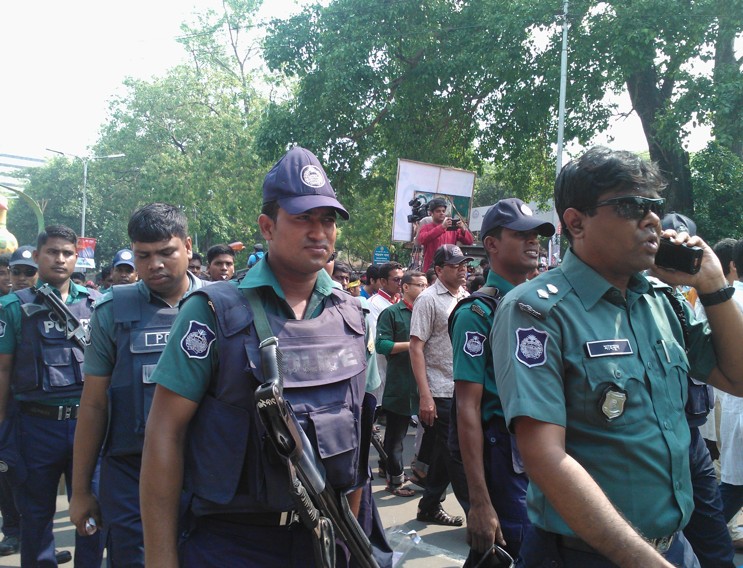
Bangladesh police: Photo: CC BY SA
19 November 2025: Bangladesh remained mostly calm on Wednesday, though a sense of tension persisted as security forces kept a heightened watch across major cities following the Awami League’s call for nationwide protests against the death sentence given to its leader and former prime minister Sheikh Hasina.
Despite the political unrest, daily life in Dhaka and other metropolitan areas slowly began returning to normal, with traffic improving and no fresh incidents of violence reported for the second straight day. Law-enforcement agencies—including armed police, the Rapid Action Battalion, and paramilitary units—continued heavy patrols around sensitive locations such as government offices, political party headquarters, and key intersections in the capital. Several neighbourhoods remained under tight security, with checkpoints and barricades restricting movement in anticipation of the Awami League’s three-day protest programme beginning Wednesday.
The Awami League, in a social media statement on Monday, had called for a complete shutdown on Tuesday followed by “nationwide demonstrations, protests, and resistance” from November 19 to 21, describing the verdict against Hasina as “politically motivated.”
Elsewhere, in Gazipur, a fire engulfed a warehouse owned by a Jubo Dal leader, destroying stored goods, according to Bangladeshi daily Prothom Alo. It was unclear whether the fire happened accidentally or was deliberately set. Jubo Dal is the youth organisation of the BNP, led by Khaleda Zia, which has become the dominant political force after the dissolution of Hasina’s Awami League.
Meanwhile, police arrested 1,649 individuals during nationwide raids conducted on Monday and Tuesday as part of ongoing security drives, reported the newspaper Jugantor. Officers also seized ten firearms, 30.5 kg of gunpowder, ammunition, and several crude bombs.
On Monday, Sheikh Hasina, aged 78, was sentenced to death in absentia by Bangladesh’s International Crimes Tribunal on charges of “crimes against humanity” relating to last year’s violent crackdown on student-led protests. Former home minister Asaduzzaman Khan Kamal received the same sentence on similar charges.
Hasina has been in India since August 5 last year, when she fled Bangladesh amid widespread mass demonstrations. In her response to the ruling, she rejected the charges as “biased and politically motivated,” saying the judgment was issued by a “manipulated tribunal” formed by an “unelected government with no democratic authority” and driven by “malicious, retaliatory, and vengeful intent.”