Iran Women’s Football Team Faces Uncertain Future After Asian Cup Anthem Protest
Melbourne, 7 March: The Iranian women’s national football team competing in the AFC Women’s Asian Cup 2026 in Australia has found itself at the centre…




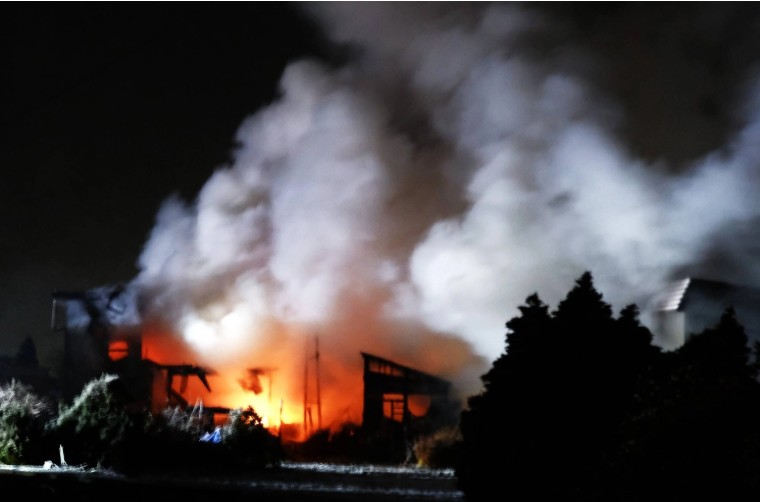
Tokyo, 9 December: Japan has lifted all tsunami advisories after a powerful earthquake struck off the country’s northern coast late Monday night, triggering widespread panic, traffic chaos, and injuries across several regions.
The earthquake, measuring approximately 7.6 in magnitude, hit offshore and was followed by tsunami waves of up to about half a metre that reached parts of Japan’s northeastern coastline. Authorities initially issued tsunami warnings, which were later downgraded to advisories before being fully lifted on Tuesday morning as conditions stabilised.
Residents described scenes of fear and confusion as the ground shook violently. In Hachinohe, convenience store owner Nobuo Yamada told public broadcaster NHK that he had never experienced such intense shaking in his life. Another resident, Satoshi Kato, vice-principal of a high school in the same city, said he was at home when glassware and bowls fell and shattered across his floor.
Kato later drove to his school, which had been designated as an evacuation centre. He reported that roads were heavily congested as people attempted to flee, leading to severe traffic jams and multiple car accidents amid the panic.
According to Japan’s Fire and Disaster Management Agency, at least 23 people were injured in the quake, including one person who was seriously hurt. Most injuries were caused by falling objects, NHK reported. Several people were injured at a hotel in Hachinohe, while a man in the Tohoku region sustained minor injuries after his car fell into a hole. Around 800 households remain without power as of Tuesday.
The Japan Meteorological Agency has warned that aftershocks may continue in the coming days. It also noted a slight increase in the risk of a magnitude-8-class earthquake and possible tsunami along Japan’s northeastern coastline, stretching from Chiba, just east of Tokyo, to Hokkaido.
Concerns over nuclear safety were quickly addressed, with the International Atomic Energy Agency confirming that no abnormalities were detected at the Fukushima nuclear power plant, the site of the catastrophic accident following the 2011 earthquake and tsunami.
In Aomori city, the aftermath of the quake extended beyond tremors and waves. Early Tuesday morning, a fire broke out at a residential home, highlighting the secondary risks often associated with major earthquakes.
With tsunami advisories now lifted nationwide and emergency responses ongoing, authorities continue to urge the public to remain cautious, follow official updates, and prepare for possible aftershocks in the days ahead.





Melbourne, 7 March: The Iranian women’s national football team competing in the AFC Women’s Asian Cup 2026 in Australia has found itself at the centre…

Melbourne, 7 March: Former advisers of Bangladesh’s interim government are increasingly coming under public scrutiny as one corruption allegation after another begins to surface. Those…

Melbourne, 7 March: Today marks Historic 7 March, a unique, unforgettable, and glorious chapter in the long struggle for freedom and independence of the Bengali…

Melbourne, March 7: The ongoing conflict between the United States and Iran has entered a new and potentially dangerous phase, with US stealth bombers reportedly…
Melbourne, 6 March: The death toll in Iran continues to rise as the United States and Israel intensify their strikes, with residents in the capital…

Melbourne, 6 March: A series of corruption and misconduct allegations have begun to surface against several former advisers of Bangladesh’s interim government, as well as…




All Rights Reserved by © OTN Bangla.com.au - 2026 | Privacy Policy | Terms of Use | Editorial Policy | Proudly Developed by @SSB it.au