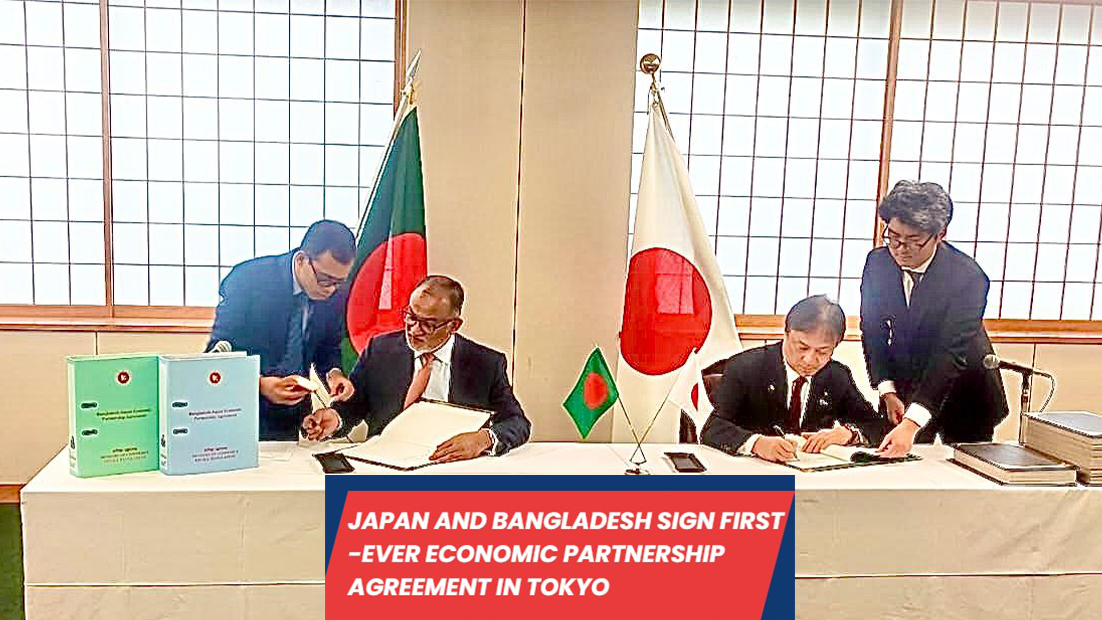
The signing ceremony marks a new phase of strategic economic cooperation between the two countries. Photo: Supplied
Melbourne, February 7: The Economic Partnership Agreement between Bangladesh and Japan was officially signed yesterday (6th February 2026) in Tokyo, marking the first time Bangladesh has concluded such an agreement with any country. The agreement was signed on behalf of the two governments by H.E. Mr Sk. Bashir Uddin, Commerce Adviser to the Government of Bangladesh, and H.E. Mr Horii Iwao, State Minister for Foreign Affairs of Japan. The signing is being seen as a milestone in bilateral relations and a significant step towards deeper economic integration between the two nations.
The agreement opens up vast new opportunities for Bangladesh’s economy by granting 100 percent duty-free access to the Japanese market for approximately 7,379 Bangladeshi products, including ready-made garments. This is expected to provide a major boost to Bangladesh’s export sector and strengthen its presence in one of Asia’s most advanced and high-value consumer markets. The inclusion of the Single Stage Transformation facility in the apparel sector will make it significantly easier for Bangladeshi garment exporters to access Japan, as it removes complex requirements related to the sourcing of raw materials and simplifies compliance with rules of origin.
The agreement also creates new pathways for Bangladeshi skilled professionals to work in Japan across 120 service sectors under 16 major categories, including information technology, engineering, education, caregiving and nursing. This provision is expected to enhance people-to-people connectivity, address skills shortages in Japan, and create overseas employment opportunities for Bangladeshi professionals.
In return, Bangladesh has agreed to provide duty-free or preferential market access to 1,039 Japanese products and 98 sub-sectors across 12 major categories, reflecting a reciprocal opening of markets aimed at strengthening two-way trade.
Beyond trade liberalisation, the Economic Partnership Agreement is expected to significantly boost Japanese foreign direct investment in Bangladesh and accelerate the transfer of advanced technology. Officials said the partnership would help improve infrastructure and logistics standards in Bangladesh, making the country more competitive in global value chains and more attractive to long-term investors. The agreement establishes a comprehensive legal framework covering trade in goods and services, investment, customs procedures, rules of origin, intellectual property and digital trade, creating a more predictable and transparent business environment for companies from both countries.
Both governments described the agreement as a strategic step towards strengthening supply chains and building a resilient, rules-based economic partnership at a time of global uncertainty. Business leaders welcomed the deal, saying it would lower trade barriers, reduce risks for investors and exporters, and encourage deeper collaboration between Japanese and Bangladeshi firms. Economists noted that the agreement could help Bangladesh diversify its export base beyond traditional sectors while reinforcing Japan’s engagement with fast-growing South Asian economies.
The signing of the Japan–Bangladesh Economic Partnership Agreement is being viewed as a gateway to a new phase of economic cooperation that goes beyond traditional trade ties.
Officials expressed confidence that the pact would translate into tangible benefits through higher trade volumes, increased investment, technology transfer and job creation, laying the foundation for a more resilient and mutually beneficial partnership between Tokyo and Dhaka in the years ahead.