Could Australia Be Drawn Into the US–Iran Conflict?
Melbourne, 9 March: As tensions escalate in the growing conflict between the United States, Israel and Iran, questions are emerging about whether Australia could become…




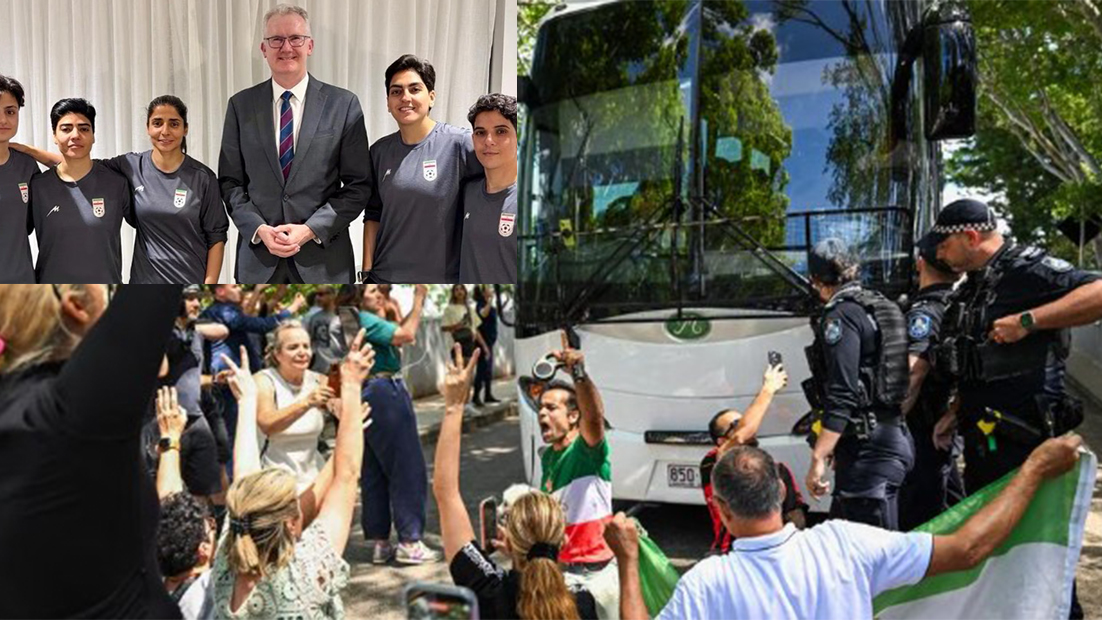
Melbourne, 10 March: Chaotic scenes unfolded outside a hotel on Australia’s Gold Coast on Tuesday after protesters attempted to block a bus carrying members of Iran’s women’s national football team to the airport, following asylum requests by several players.
Witnesses reported that several protesters stood in front of the bus outside the team’s hotel on Tuesday afternoon. One man was seen lying on the ground while holding a small white dog in an apparent attempt to prevent the bus from moving.
Earlier, Australia’s Home Affairs Minister Tony Burke confirmed that five members of the Iranian women’s football team had been granted humanitarian visas after expressing their wish to remain in Australia. The players had been staying at a Gold Coast hotel while competing in the Women’s Asian Cup.

Home Affairs Minister Tony Burke meets with five Iranian footballers after granting them humanitarian visas in Australia.
However, the remaining members of the team were reportedly transported by bus to the Gold Coast Airport domestic terminal despite attempts by protesters to stop them. Police moved the demonstrators away as a large security presence was deployed at the scene.
Reports indicate the departing players are expected to fly from Sydney to Malaysia before travelling onward to Turkey and eventually returning to Tehran by bus.
Greens Senator Nick McKim raised concerns about whether some players may have been pressured to return to Iran. Speaking to ABC, he said members of the delegation accompanying the team appeared “sketchy,” noting that at least one person had previously been denied a visa due to links with the Islamic Revolutionary Guard Corps (IRGC), which Australia has designated as a terrorist organisation.
“This is a rare opportunity to hold the regime to account for the way it treats women and girls,” McKim said, urging authorities to do everything possible to protect the athletes if there was any evidence they were under pressure.
Amnesty International also expressed concern that some players leaving Australia might not have been fully informed about their right to seek asylum. Strategic Campaigner Zaki Haidari warned that the team could face serious risks if they returned to Iran.
“They have the right to seek protection and safety in Australia and must be given the opportunity to exercise that right,” Haidari said, calling on customs and immigration officials to ensure the players were aware of their options.
The Albanese government granted humanitarian visas to five players: captain Zahra Ghanbari and teammates Fatemeh Pasandideh, Zahra Sarbali, Atefeh Ramezanizadeh and Mona Hamoudi. Ramezanizadeh later responded to a message from the Courier Mail with a prayer and peace emoji late Monday night.
New South Wales Premier Chris Minns said the five players would be warmly welcomed if they settled in the state, noting the strong Iranian diaspora in Sydney.
“There’s a big Iranian expat community in our state. They are generous, big-hearted people and very passionate about this team,” Minns said.
In a statement, the Australian Federal Police confirmed they had assisted the Department of Home Affairs in relation to the Iranian women’s football team under “Operation Harbour.”
“The AFP has long-standing relationships with the Iranian diaspora through its Community Liaison Teams,” the statement said, adding that the agency would not comment further at this stage.
Earlier, Minister Tony Burke revealed he had personally met with the five players after they expressed their desire to remain in Australia. They were moved to a secure location under police protection before their humanitarian visas were approved early Tuesday morning.
Burke said the players reacted with “joy and relief” after being told they could stay in Australia.
“There were lots of photos, lots of celebrating, and a spontaneous outbreak of ‘Aussie, Aussie, Aussie, oi, oi, oi,’” he told reporters.
Prime Minister Anthony Albanese also confirmed he had discussed the situation with US President Donald Trump, who had earlier urged Australia to protect the Iranian players.
Concerns for the team’s safety emerged after several players reportedly refused to sing Iran’s national anthem before their opening match against South Korea, an act widely interpreted as a silent protest against the Islamic Republic.
Iranian state-controlled media later labelled them wartime “traitors,” raising fears that they could face retaliation if they returned home.
Iranian-Australian community members have also warned that some individuals accompanying the team may have links to the Islamic Revolutionary Guard Corps, a paramilitary organisation of the Iranian government that is banned in Australia.




Melbourne, 9 March: As tensions escalate in the growing conflict between the United States, Israel and Iran, questions are emerging about whether Australia could become…

Melbourne, March 9: Finals are usually defined by tension, fierce competition and last-minute drama. But the T20 World Cup final in Ahmedabad told a completely…
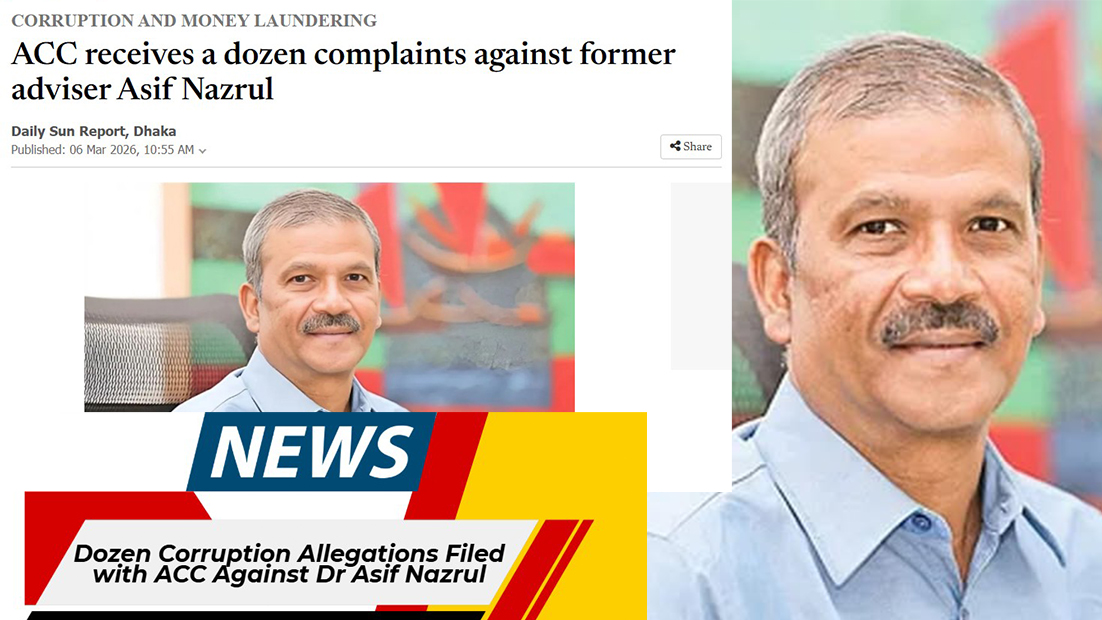
Melbourne, March 9: Bangladesh’s Anti-Corruption Commission (ACC) is reviewing a series of complaints accusing former law adviser Dr Asif Nazrul of corruption, abuse of power,…
Melbourne, 8 March: The second episode of OTN Bangla’s ongoing investigative reporting series has been released today, focusing on allegations of abuse of power and…
Melbourne, 8 March: Australian media outlet ABC, in its analysis titled “Women’s Asian Cup 2026: Plucky Bangladesh teases much-needed jeopardy,” noted that Bangladesh has injected…
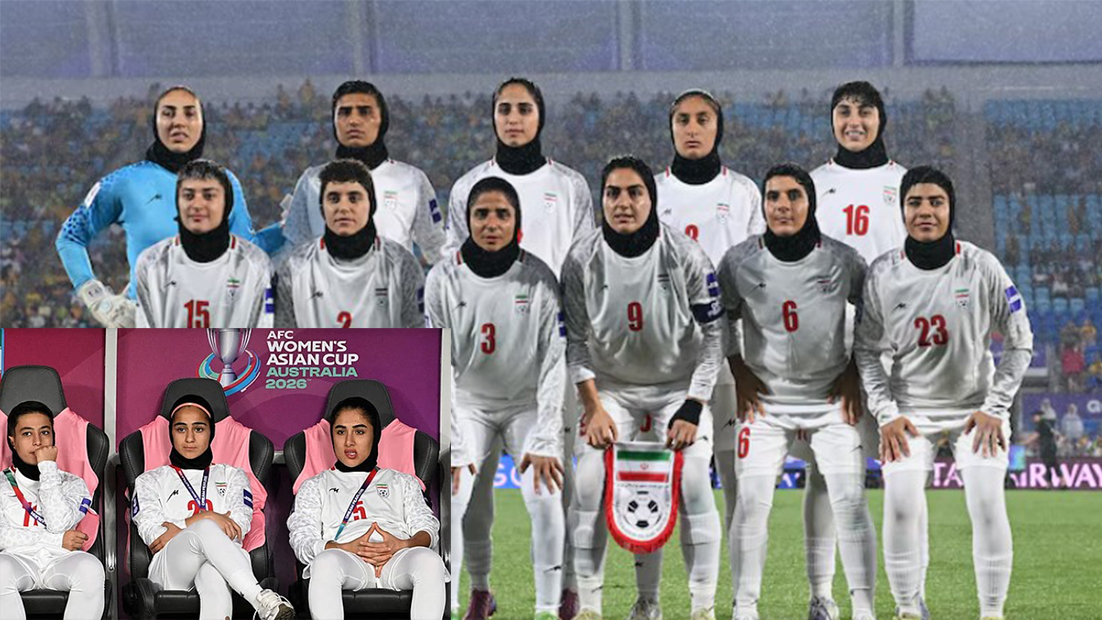
Melbourne, 7 March: The Iranian women’s national football team competing in the AFC Women’s Asian Cup 2026 in Australia has found itself at the centre…




All Rights Reserved by © OTN Bangla.com.au - 2026 | Privacy Policy | Terms of Use | Editorial Policy | Proudly Developed by @SSB it.au