Melbourne, 26 December: After 17 years of self-imposed exile, Bangladesh Nationalist Party (BNP) Acting Chairman Tarique Rahman has returned to his homeland, marking one of the most emotionally charged political moments in recent Bangladeshi history.
From across the country, thousands of BNP leaders and supporters gathered in Dhaka, braving severe cold through the night just to catch a glimpse of him. Many slept on the streets wrapped in blankets and polythene sheets, lighting small fires with straw to stay warm. A massive 300-foot stage was set up in Purbachal, where Tarique addressed a sea of supporters.
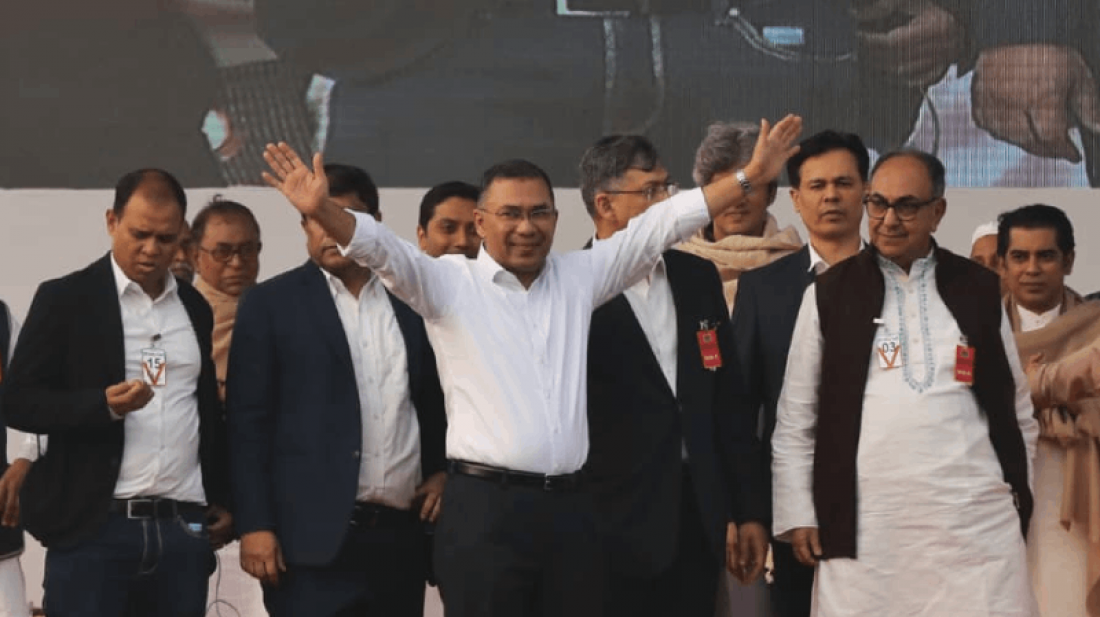
When he appeared on stage, he made a symbolic gesture by removing the luxurious chair prepared for him and choosing instead to sit on a simple plastic chair. Waving to the crowd, he said:
“We want to build a country where a mother can be certain about the safety of her child. Hindus, Muslims, Buddhists, Christians, people from the hills and the plains must all live with equal rights.”
Tarique Rahman, son of former Prime Minister Khaleda Zia and late President Ziaur Rahman, had left Bangladesh in 2008 while facing multiple charges related to bribery and money laundering. Since then, the country has passed through a prolonged period of institutional decay, centralised corruption, rigged elections and shrinking democratic space, which eventually exploded into last year’s July Uprising.
That uprising forced the fall of the Awami League government led by Sheikh Hasina, but the interim government headed by Nobel laureate Muhammad Yunus has failed to fulfil the promises of the movement. A dangerous political vacuum emerged, allowing far-right and extremist forces to grow. Shrines of alternative Islamic traditions were attacked, minorities were harassed, Awami League leaders and freedom fighters were targeted, and media houses such as Prothom Alo and The Daily Star were vandalised. Cultural institutions like Chhayanaut and Udichi were also attacked. The brutal killing of a minority man following the death of youth leader Sharif Osman Hadi further highlighted the rise of mob rule.
Against this backdrop of chaos and uncertainty, Tarique Rahman returned at 11:40 am to a hero’s welcome. He arrived on a low-carbon Airbus with his wife Zubaida Rahman, daughter Zaima Rahman, and their pet cat Zeebu, which quickly became a media favourite. Upon landing, he touched the soil of Bangladesh with his bare feet and stood quietly for a moment, paying silent respect to his homeland.
In his speech, which began with the words “Dear Bangladesh”, Tarique recalled the Liberation War of 1971 and thanked God for allowing him to return to his country. He reminded the crowd that Bangladesh had repeatedly been rescued from non-democratic and authoritarian regimes in November 1975, 1990, and again in 2024.
His message focused on unity, communal harmony and protection for women, children, the disabled and ordinary citizens, regardless of class, religion or gender. Referring to the late Sharif Osman Hadi, he said Bangladesh must honour all martyrs of 1971 and of subsequent authoritarian regimes by becoming a safe and dignified country worthy of their sacrifices.
He urged BNP leaders and activists to remain patient, calm and united, warning that conspiracies were still being hatched.
“The spies of hegemonic forces are still active. We must stay extremely calm and steady,” he said.
Tarique also called on young people to take responsibility for rebuilding the nation and repeatedly stressed the importance of peace and order.
His political schedule includes visiting the grave of his father, Shaheed President Ziaur Rahman, and paying homage to the martyrs of the 1971 Liberation War at the National Memorial in Savar. He will also complete his voter registration, visit Hadi’s grave at Dhaka University, and meet injured fighters of the July Uprising at the Pangu (Disabled) Hospital.
Despite being in exile, Tarique Rahman never left the political arena. From abroad, he guided BNP strategy, restructured the party and coordinated leadership digitally. Although mocked by the Awami League as a “Zoom leader,” this digital bridge helped BNP survive years of authoritarian pressure and gradually regain public credibility.
His return comes at a fragile and decisive moment in Bangladesh’s political history. It places him at the centre of national politics ahead of the next elections, making him the de facto leader of the BNP and a key figure in shaping the country’s future.
While BNP’s dominance raises concerns about political balance, it remains the only major moderate force capable of countering the growing influence of far-right and extremist alliances. With the interim government politically weak and the old ruling party largely discredited, leadership in Bangladesh is now likely to be judged by continuity, capacity and public recognition. In these areas, Tarique Rahman has emerged as a national figure rather than merely a party leader.
His 31-point reform agenda signals a move from resistance to governance, emphasising institutional independence, rule of law, accountability and socio-economic recovery. His inclusive rhetoric, focused on reconciliation rather than revenge, frames his return as a chance to restore democratic competition and bring power back into the hands of the people.
How Tarique Rahman leads the BNP, and potentially the government in the future, will play a crucial role in shaping Bangladesh’s democracy, governance and public welfare in the months and years ahead.