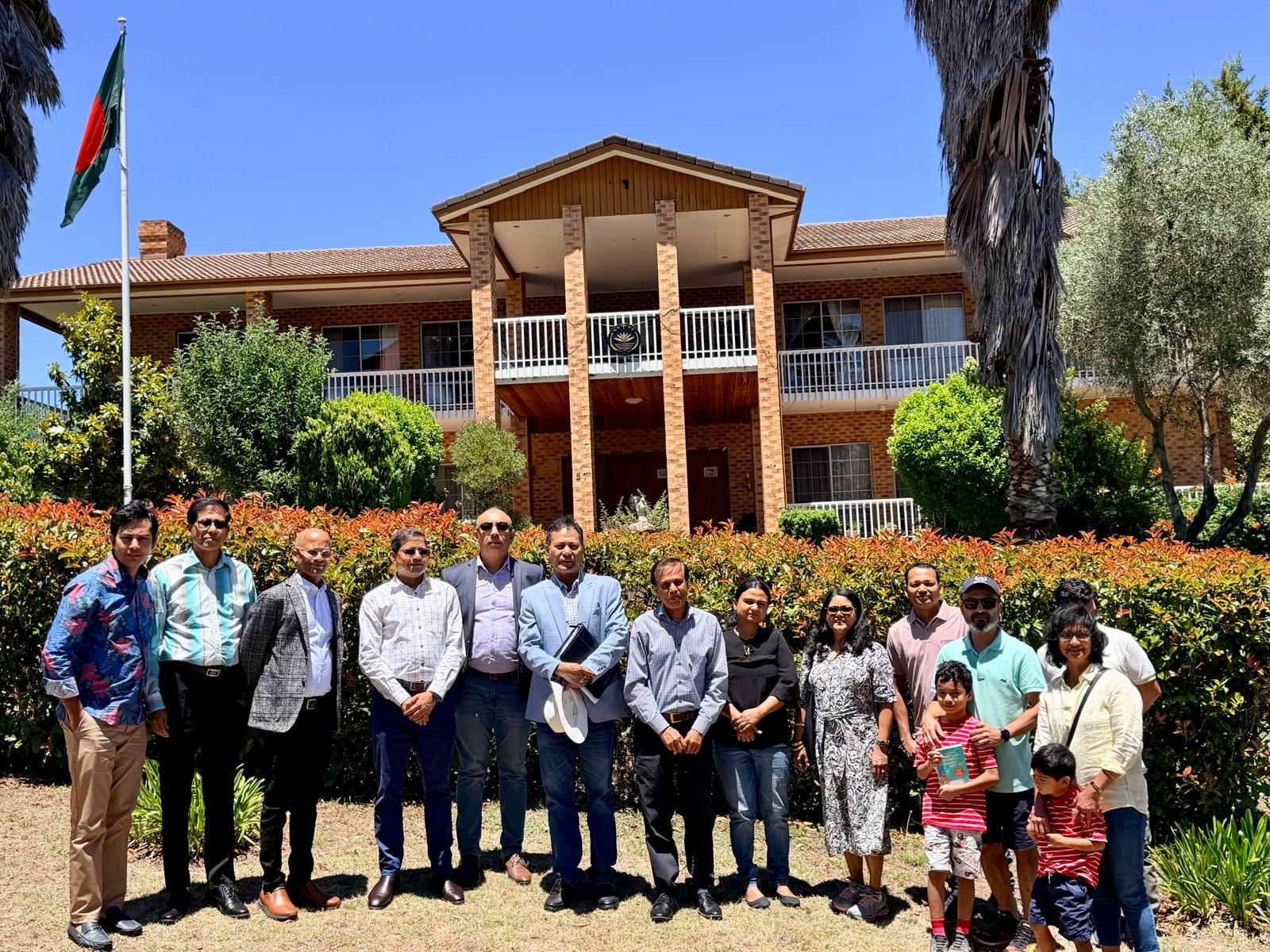
AFERMB delegation submits a memorandum to the Bangladesh High Commission in Canberra on 23 December 2025, raising concerns over the killing of Dipu Chandra Das and growing violence against religious minorities. Photo: supplied
Canberra | 23 December 2025: A delegation from the Australian Federation for Ethnic and Religious Minorities in Bangladesh (AFERMB) visited the Bangladesh High Commission in Canberra on Tuesday, 23 December 2025, to formally submit a memorandum addressed to the Honourable Chief Adviser of the People’s Republic of Bangladesh, Professor Muhammad Yunus.
The delegation conveyed deep concern over the brutal extrajudicial killing of Mr Dipu Chandra Das, a young Hindu factory worker who was lynched in Bhaluka, Mymensingh, on 19 December 2025 following a fabricated allegation of blasphemy. The memorandum was handed over to the Minister/Chargé d’Affaires of the Bangladesh High Commission, who expressed empathy regarding the issues raised. He assured the delegation that the memorandum would be discussed with the High Commissioner upon his return and that appropriate steps would be taken.
In its letter, AFERMB, a registered Australian charity and umbrella organisation representing 28 Australian-registered Bangladeshi diaspora community organisations, described the killing of Dipu Chandra Das as an act of unspeakable brutality. According to the memorandum, Mr Das was publicly lynched by a mob, hung from a tree, and set on fire. Police officials were quoted as stating that the blasphemy allegation was extremely vague and that no one could clearly explain what Mr Das had allegedly said.
The memorandum further stated that credible information indicates the incident was deliberately engineered by workplace rivals who exploited Mr Das’s religious identity to remove him from employment, ultimately leading to his death. AFERMB described the killing as a grave violation of the fundamental right to life, freedom of religion, and due process, and as part of a broader and deeply troubling pattern of misuse of blasphemy allegations against religious minorities in Bangladesh.
AFERMB noted that this incident does not stand in isolation. The organisation cited a series of recent incidents, including targeted attacks on Hindus in Gangachara, Rangpur; the brutal sexual assault of a Hindu woman in Muradnagar; mob violence following false blasphemy allegations in Lalmonirhat; the persecution and misuse of legal processes against Shri Chinmoy Prabhu; and ongoing human rights violations against Indigenous communities. Taken together, the memorandum warned, these developments threaten Bangladesh’s democratic aspirations and social harmony.
The letter also highlighted the long-term demographic decline of Hindu and other religious and ethnic minority populations in Bangladesh, arguing that this trend is not driven solely by migration or economic factors. Instead, AFERMB attributed it to prolonged hostility, recurrent communal violence, discriminatory practices, official indifference, and sustained state inaction, which have fostered a culture of impunity. The organisation observed that arrests often occur only after widespread media attention, followed by release on bail or minimal penalties, further emboldening perpetrators.
Expressing serious concern, AFERMB pointed to statements from certain quarters of the administration referring to violent mobs as “pressure groups,” warning that such language risks legitimising mob violence and undermining the rule of law. The memorandum stressed that a society governed by law cannot allow vigilantism to replace justice, and that all allegations against any citizen must be addressed strictly through legal and constitutional processes.
On behalf of Bangladeshi diaspora communities, AFERMB urged the Interim Government to take immediate, decisive, and transparent action. The organisation called for full state responsibility for the welfare, protection, and rehabilitation of Dipu Chandra Das’s family, including his 1.5-year-old daughter; prosecution of all perpetrators and instigators under the Speedy Trial Tribunal without exception; a clear public reaffirmation of zero tolerance for mob violence and communal hatred; prevention of the misuse of blasphemy allegations as a tool of persecution; and swift, impartial investigations into all incidents of mob and communal violence.
Concluding the memorandum, AFERMB stated that members of the Bangladeshi diaspora are deeply concerned about the safety and security of their families and loved ones in Bangladesh. Looking to Professor Muhammad Yunus’s leadership, the organisation appealed to the government to act with moral courage and constitutional responsibility to safeguard the dignity, rights, and lives of all citizens, irrespective of religion, ethnicity, or background.